Monday, September 29, 2014

Adding links to images in Office365 for ePortfolios

PART 1: CREATING A SITE AND ADDING PICTURES
PART 2: (Below) ADDING A PAGE TO LINK TO
 
Step 1: Login to Office365. Select Sites on top right hand of screen

Step 2: Click 'new' as above

Step 3: You will be prompted to name your site

 
Step 4: On the right, click EDIT on the right hand side of the screen as above

 
Step 5: Click on INSERT on the ribbon and choose Picture - choose the picture you would like to use (e.g. photo of student, topic, avatars)
 

Step 6: Select the picture you want to add a link to by clicking on it


Step 7: Click on LINK on top left of ribbon - add the link you want to go to
 
 
Step 8: Click 'save' on top right to exit editing view
 
 
HANDY HINT: Click on 'Open in new tab' so it doesn't navigate away from the site
 
PART 2: ADDING A PAGE TO LINK TO


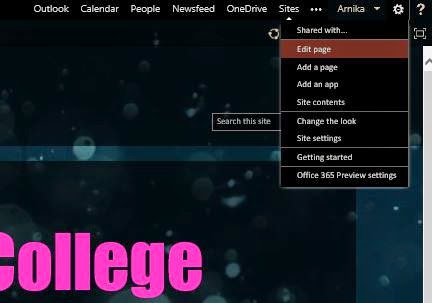
Step 1: Click on the settings cog on the top right of the page

Step 2: Select Add a page


Step 3: You will be prompted to name it
 
 
 Step 4: You can also copy and paste the link from there.


Step 5: Paste the link into the Insert Link when you click on the image
 
 
HANDY HINT: If you lose the page
- Click on the settings Cog
- Click on Site Contents
- Click on Site Pages
You will see a list of pages as above


Tuesday, April 29, 2014

My eLearning Personal Statement for Emerging eLeaders 2014 with Core Education


Arnika Brown eLearning Personal Statement

E-learning is extremely valuable to education. It is a broad term being used globally in education and refers to any kind of learning using ICT.

Schools need to ensure that the children have access to –

    • Up to date Information Communications Technology hardware and software to allow eLearning to happen successfully.
    • Qualified and trained staff to ensure learning is enhanced through the use of eLearning and ICT.

Using technology I have seen students succeed over and above what they would have without technology. E-learning gives students the chance to work beyond the classroom walls and construct knowledge they never had the opportunity to before. E-learning is not when paper is replaced with a tool. “Simply equipping students with their own devices and digitising existing curriculum is not the right approach.” (Dixon, B. et al, n.d.) It is when learning has no boundaries. When eLearning is empowering, students will be engaged in the following 21st century skills: Collaboration, Knowledge Construction, Self-Regulation, Real-world Problem-solving and Innovation, Use of ICT for Learning, Skilled Communication (ITL Research, n.d.)

It is not enough to provide the students and teachers with the concept of eLearning, there is a certain responsibility that comes with it. In order to implement eLearning successfully across the school, calculated steps need to be taken. Schools need to ensure they have a vision. Without vision it can be a long, windy, frustrating road to eLearning implementation. “Vision and goal setting is best done after first researching not only other 1:1 initiatives, but global and economic trends and the reality of the technology rich world in which today's students live.” (Dixon, B. (n.d). Retrieved from http://www.aalf.org/cms/?page=AALF - 21 Steps to 21st Century Learning)

Schools may also use a change model to ensure effective uptake of eLearning. As there will always be a range of adopters and learners, schools must ensure that they provide adequate support and guidance for all staff members.  “Many innovations require a lengthy period of many years from the time when they become available to the time when they are widely adopted. Therefore, a common problem for many individuals and organizations is how to speed up the rate of diffusion of an innovation.” (Scott, 2012)

The eLearning Planning Framework includes really positive examples of how eLearning should be used. In order to ensure all schools are in the empowering phase, there must be a whole school approach. eLearning is not about 1 Teacher being passionate about ICT and sharing their experiences. It is about embedding it into the pedagogy and school culture.

E-learning supports all members of the school community to communicate and opens up opportunities for collaboration we have not ever had access to before.

Reference list:

Dixon, B. (n.d). Retrieved from http://www.aalf.org/cms/?page=AALF - 21 Steps to 21st Century Learning

Dixon, B. AALF. Teirney,S. Microsoft Corporation. (n.d) Bring Your Own Device to School. Microsoft Corporation. United States.

Innovative Teaching and Learning Research (n.d) 21st Century Learning Design Student Work Rubrics. Microsoft Corporation

Ministry of Education. (2013). eLearning Planning Framework. http://www.elearning.tki.org.nz/Professional-learning/e-Learning-Planning-Framework2

Scott. (2012) Diffusion of Innovation: The Difficulty of a New Idea. Retrieved from http://insidefinance.org/diffusion-of-innovation/

Monday, October 7, 2013

latest skill- full screen on app

My final edem630 post...our daughter on the Microsoft surface Rt. 19 months old. Who said windows 8 was hard? Enjoy

Sunday, October 6, 2013

EDEM630 Assignment 2.1 Final Reflections and Participation Requirements

Assignment 2.1 

Two learning reflections:
http://arnikabrown.blogspot.co.nz/2013/09/reflection-3.html#comment-form
http://arnikabrown.blogspot.co.nz/2013/07/some-reflecting-on-rogers-diffusion.html
Two E-activities: 
http://arnikabrown.blogspot.co.nz/2013/09/elearning-planning-framework.html
http://arnikabrown.blogspot.co.nz/2013/07/mindmap.html

I am currently sitting in Raglan looking out at the sea. This week I will be attending ULEarn in Hamilton where I feel a lot of the new knowledge and skills I have gained through this course will come into context.
It certainly has been a journey. Taking on this paper proved to be challenging and full on, but I am feeling confident as I am about to upload my final assignment.
I have appreciated the support from Wayne and Niki and all of our classmates throughout.
I have really enjoyed becoming a Tweeter, and the networking that has all happened before me has been priceless.
As I type my final reflections I think back to when it all started and I felt so incredibly overwhelmed by the work expectation and the information overload. I wondered what I was doing taking on motherhood, full time work and another University paper. Now, as a result I am feeling a real sense of achievement. All going well I have a paper to choose from the Masters section next year and I will have my Post Grad all done and dusted.
Scenario Planning has supported me to change the way I look at implementation of technology into schools. I have been lucky enough to be embarking on a new employment opportunity as Microsoft Education Specialist through Cyclone Computers as of October 21st. Part of my job is supporting schools to implement new technologies and changes. I feel as though the new knowledge I now have of changes in digital technologies will absolutely support me in my new role. I think Scenario Planning is a vital tool and I am so excited that I will get the chance to share my knowledge with a wealth of educators across New Zealand.
I have enjoyed reading others posts and contributions. Everytime I have felt a certain way it has been nice to know there are others feeling that way too, at the end of the day we all got through it.
I have enjoyed setting up and using the blog. The reflections have been meaningful and are a great tool to go back over to 'reflect' on how I felt earlier and see how far I have come.
The MOOC was full on. It was a great opportunity to be a part of it and get a real feeling of the remix of media first hand. I have since seen the word MOOCs used a lot on Twitter and it is refreshing to know what people are talking about. I definitely have a wider vocabulary and comprehension of digital technologies and issues surrounding them.
The change models I have referred to in my articles will definitely support me in my new role which is really fantastic. It is so great to be able to shift the knowledge I have fined into a new context for me and still be able to use it...maybe my own wee remix....
I have added my Self Assessment Rubric below.

Sunday, September 8, 2013

Reflection 3


So far......wow, we have covered a lot in this course. I feel as though this is the most diverse paper I have taken. When I think back to my first blog post with a video, and how much I know now I really don't know where to start.
I have learned a lot through out the course. The academic essay on online tutorials created a meaningful research road for me to go down. That is 1 of the things I have really enjoyed about the course, everything has been meaningful learning.
As I have said in previous posts, the change models are realistic to my school setting and I enjoyed putting them into context. For me, at the beginning of this course I was someone who was passionate about technology in education. Now I am passionate about others seeing what the changes are and why things need to change. It's not just about the technology anymore for me, but thr process of change and supporting others to get there.
Scenario planning is a great way to think forward. We have ERO early next term so I will be interested to find out if they have seen examples of this in schools. This term I had the opportunity to create my entire planning folder in a OneNote notebook. This was a trial that I am going to show ERO, and hopefully create some change within my school. I have learned that scenario planning also has to look at sustainability as well as change and I feel that this type of planning involves both.
The annotated bibliography is a great way to find out information in a meaningful way. A friend of mine wished all her assignments had one to support them, she loved it and was thinking about doing one for her research personally.
I am still unsure about using the scenario matrix in context. I got enough of a handle on it to understand what I was doing, but feel as though I would still struggle to apply it to my school.
It is a relief not having such a full on course schedule this time around. The mooc had a lot of useful and insightful information, but I really felt like some of it was over my head. I appreciated that most members led conversations around most topics which clarified a lot for me. I learned a lot in a small amount of time, which sitting back, I can now appreciate.
I feel as though I have started to think about technology on such a deeper level now. I can take the ecological perspective of my society into consideration when scenario planning, and I actually know what that means. This course has made me think more about the bigger picture of the changes, it's not just about us in our classroom, but it's about our students community and everyone around us. It has made me more aware of keeping those around the school involved by informing them of changes and just keeping them up to date.
The ElPF has opened up my eyes to where the school I work in may be, and where I want it to be. I have discussed it with my Principal and he was very keen to integrate it into our review process. I am keen to discuss it with ERO and see what their thoughts are.
I have enjoyed becoming part of the class and this has been much easier with the use of twitter and blogs and forums. I have felt as though there has been a lot of support, and it has been easier to push on through when you know someone else is feeling the same.
I want to know more about e-mature schools. I would love to see one in action. I wonder if these schools have specific staff members running the focus or if everyone is on board. I also wonder how they get everyone on board.
At this stage I still have so much to learn. I feel I have only just touched the surface of changes in technology. I would like to learn more about implementing scenario planning into primary schools, and more about using the elpf to create change in a primary school setting.

Elearning planning framework

I have selected a small rural Primary school in the South Island of New Zealand. The school had a role of 90 students and has 5 Teachers. The schools current e-learning approach is characterised by 1:1 learning in one classroom, a couple of passionate staff and a Board of trustees who in the past has been supportive of e-learning. 
  • Summary of the 5 areas
Leadership and strategic direction
This school is at an engaging level. There is a strong management team in place. The skills from management are constantly being shared with staff, and there is professional development apparent within the school around e-learning. There is also an expectation that Teachers are aware of the e-learning going on in the school and have input as to where to next.

Professional Learning
I would say the school is at an extending level. This is supported by the networking available for Teachers in the wider community associated with the school. There is also quite a bit of professional development available through funding from the MOE which has supported the professional development of the staff. The school has just started using the Teacher as Inquiry model as part of their Appraisal process. Their next step is to use this as part of their professional development and needs around ICT.

Beyond the Classroom
The school is at the engaging level. They have constant communication with the BOT about their successes and hopeful next steps in technology. The parent community are fully aware of the integration of ICT into the classrooms, but their are no reports as such as to how it is going.

Technologies and Infrastructure
The school is at the emergent level. The school has quite a few resources but there isn't a collaborative feel through out classrooms. The support within the school is focused around professional development, not so much the technologies. Some of the technology is outraged and running into problems, and the infrastructure is not totally capable of running all the wireless devices available at the same time.

Teaching and Learning
The school again would be at an emergent level. Although some of the classes may be technology rich and practising integration into other curriculum areas and assessment, it is not school wide.

The evidence comes from observations of classroom practice.  I also had numerous conversations with staff and the principal of the school.

Disclaimer: This assessment was conducted as a personal learning exercise to gain understanding of the eLPF and the assessments are restricted to public documentation without detailed insights into all organisational processes.

Sunday, August 18, 2013

Reflection 2


I have learned to much in my journey through EDEM630 so far. One of the most interesting things has been applying change to the models. The learning/Adoption trajectory has been the most meaningful so far, and I found it easy to apply to my research in Assigment 1.1.
The MOOC was really interesting and full on. At 1 point I was totally overwhelmed and emailed Niki and Wayne about the prospect of withdrawing. I thank them for their support and encouragement. I have now submitted assignment 1.1 and will submit 1.2 by the end of this week.
I have completed my scenario matrix but I still have a lot of work to do around this before I really understand the whole concept. I am hoping this will come through my work on Ass 1.2.
Scenario planning seems like a plausible and sensible way to go about running life in general. I think it is so vital to look through to the present, not live in the past. We have started to use this in our planning, instead of going historically with how we have been teaching, we have been looking at how to move forward and what we actually need to teach the students. It will be interesting to see what ERO think in Term 4 Week 1.
I am very pleased we were given an extension on our assignments. This is one of the most supportive courses I have been enrolled in by distance learning. I have enjoyed getting to know people through Twitter and their blogs. It has definitely given me a sense of belonging within our group. The sp4Ed feed is very cool, although everytime I log in it makes me feel as though I am not contributing enough. I do have to remind myself to check in all places for feedback and support. I have saved all my webpages to visit into my EDEM630 folder on my bookmarks bar (something I learned this year and sooo helpful).
I feel that there has been so much knowledge for me to get my head around and not enough time for me to do it. I am really enjoying the learning, and I am just managing to sneak enough time in for the basics but feel as tough there is so much more to it.
Every week I have had to prioritize something whether it has been work, motherhood, or study.  This weekend has been interesting...I finally felt like I had everything under control and then on Fri morning we had the scare of our life with Tyler waking up with croup and not being able to breathe in properly....So we had the ambulance and our Dr here at 4am. They put oxygen on her with adrenline in it (who knew) and gave her steroids. She perked up and we kept her on steroids for the next night and she is much better, phew...... had Friday off with her which was actually very refreshing and just so nice to have a day with my girl. We then set up for our open home on Sat, Tyler woke up coughing and then vomited all over the freshly mopped tiles on our way out...had to laugh!! Finally got out the door and over to Nanas so dave and I could go out for my cousins 30th last night....then back onto the computer today for some more study.....I don't think I could have scenario planned for that one.

Some questions I still have...How can we motivate teachers who are still unsure of technology?
Will ict become part of a BTchLn qualification? It would be interesting to see with the likes of Wayne and Niki being on staff at UC if scenario planning was used for our qualifications if things changed, or they may have since I graduated.

Looking forward to finishing Ass 1.2


Tuesday, August 6, 2013

Scenario matrix


Drivers of change in education

Here is a list of drivers in change in education.
  • Openess - open content, open data, open resources
  • MOOC
  • Informal learning
  • Role of educators
  • Online learning
  • Games based learning
  • School strategy
  • Student voice
  • Virtual learning environments
  • Personalized learning
  • Project based learning
  • Research
  • Accountability
  • Competition
  • Accessibility
3 major trends significant to my context.
  • Student voice
Definition: Giving the students an opportunity to influence their own learning. 
I selected this trend because I feel as though student voice would have an impact of the kinds of video tutorials the Teacher would select. Students give warranted feedback about what is and what isn't working and I feel it is important to teaching and learning.

  • Role of educators
Definition: The role of the educator is the role of the person in charge of the content being administered.
I selected this trend because I think that the roles are changing and it needs to be addressed. Teachers can't ignore the fact that with the changes in education, changes in their roles as educators need to happen. It is important for my context because teachers still have a role to administer video tutorials.

  • Virtual Learning Environments
Definition: An e learning education system
I selected this trend because it is important to online tutorials. You can have environments where the Teacher has specific tutorials embedded for student use.

To be honest I had quite a bit more written but Blogger has been playing up and it didn't publish it so when I went back it hadn't saved my final post...so this is what it is....


Saturday, August 3, 2013

Scenario from the perspective of a decision maker

So from what I can gather we can pick and choose who we are looking through the lens as, and what our school may be characterised as. This isn't any reflection of the current role I am in now, I am purely relating it to the reading I based my scenario on. 
I chose the reading Teacher Networks. Today's and Tomorrows Challenges and Opportunities for the teaching profession. I chose this because I come from a rural school and we are quite isolated, and I am the only Year 6,7,8 Teacher so it takes effort to network and communicate with other Teachers outside of our walls.If I was an Area Leader for ICT then it would be absoloutely mandatory for Teacher to share knowledge and ideas around ICT for those Teachers in that area to gain new skills and have confidence in their own. This is also meaningful to me too as I have started 'etwinning' through this course with my twitter, blog and WE profile.
Vuorikari, R. Garoia, V. Punie,Y. Cachia. R, Redecker, C. Cao, Y.  Klamma, R.  Cuong Pham,M.  Rajagopal, K. Fetter, S. Sloep, P.(2012). Teacher Networks Today's and tomorrow's challenges and opportunities for the teaching profession. Brussels, Belgium: European Schoolnet.

My decision-making context:

I am reviewing the scenario through the lens of a highly motivated Area Leader in ICT (e.g North Shore, Mid Canterbury, etc)  who wants teachers to share their learning and skills to motivate others. My School is characterised by having lots of relevant, working ICT resources, but not a lot of communication between staff.

Overview of the scenario: 


"The teachers Lifelong Learning networks (Tellnet) project used eTwinning as a case study example of a Teacher network. The aim was to identify the main structures and mechanisms that are effective in sharing practices and encouraging innovation and creativity among teachers" 


Vuorikari, R. Garoia, V. Punie,Y. Cachia. R, Redecker, C. Cao, Y.  Klamma, R.  Cuong Pham,M.  Rajagopal, K. Fetter, S. Sloep, P.(2012). Teacher Networks Today's and tomorrow's challenges and opportunities for the teaching profession. Brussels, Belgium: European Schoolnet.


The authors proposed the 5 scenarios below. 


Scenario 1  eNet: European Education Network - Expansion of eTwinning as centralised network
Scenario 2  MyNetwork  - User-centred social network approach 

Scenario 3  Intelligent Agents  - Technology-focused approach 
Scenario 4  Diversified Teaching Career - Autonomous learning and teachers as mentors
Scenario 5  Informal Learning Camps - Bottom-up peer learning 


Scenario 4  Diversified Teaching Career - Autonomous learning and teachers as mentors


In relation to this scenario there are many factors which would be drivers for change there are the Teachers role,  significance of networking, having the resources, time, funding, student involvement, 21st century schools and support from local communities and people in leadership roles.


Brainstorm list of recommended decisions:

Scenario 4  Diversified Teaching Career - Autonomous learning and teachers as mentors

Time is a very interesting one for me and if I was driving this scenario it is something I would take into consideration. Teachers are very busy and although we all like to think that whatever we are passionate about is the key element of teaching, we all have different ideas. I have recently been involved in some PD around ICT through the Mid Canterbury Fibre Connected Schools and whenever we have something to do they offer a release day in return. I think this is a great idea and it motivates me to want to be involved because I feel as though they take my time as seriously as I do. Time is precious, and if you can value that for Teachers I think they would put more into what you are trying to achieve. In this case I would give Teacher release time to be involved in this scenario, assuming I had funding for it (in a perfect world).


This scenario would need someone timetabling the networking initially so I would set up meetings so Teachers could get to know each other face to face (if in a district) and then start to see the benefits of sharing and briefly catching up online. This would also show them how time can be saved e.g. no traveling, at your own pace, and you choose the time of day.


In order to make the networking significant there would need to be an initial brainstorm of what Teachers wanted to network about. We would need a set of guidelines to start off with e.g. Great online Maths tools, Story Starters, etc. It would then expand from there once teachers were comfortable eTwinning their ideas.


Devices - I have started to feel as though there is a huge emphasis on what we are 'using' as oppose to what we are 'doing' as educators in the 21st century. For me it is about how we use the device and that we actually use it. Networking would be based around curriculum areas as oppose to devices. I have found that if someone has a great idea on an iPad, it can be tweaked to match another wireless device. Therefore I will encourage Teachers to network around what they are doing and how they are doing it as oppose to what they are using.


Teachers need to be accountable to be involved so I would ask for feedback and reflections on the proposed scenarios.


I am sure I could write all day about this, but as Wayne has implied so often, skim read and make main points.


Two most important strategic decisions: 


Devices -I think this is very important. There is such a strong emphasis on what we are using. It is constantly talked about in staff rooms, in local papers and when networking. I feel as though Teachers need to be reminded that any ICT resource can be used to support learning and it is not a competition of who has what in the Teaching world. We are away from the 1 size fits all model, so we should be able to taylor any device to what we need. It is so important for Teachers to network about the 'things they are doing' because I come across Teachers doing great things everyday that say, but I don't have an ........ so I am not doing as well as ...... I just feel as though you can give 1 teacher a digital camera and with networking they can achieve so much more and become so much more confident than a teacher with an ipad who tries to go at it alone.


Reflecting - This is a really important part of scenario planning and because my scenario has so many drivers of change I think it would be a great tool. Teachers and the students can use assessment techniques, video, photos, conversations, tweets, blogs or whatever they want to to share their successes and their challenges. In the long run if we are sharing these stories it will start to save each other time as we can see "They have tried that, didn't work" or "I like that if I tweak it I can use it"


Transferability of recommended decisions for the scenarios alternatives:

I think that my decisions are important in any teaching/ classroom context. They are relevant to the 21st century classroom and would work equally well for alternative scenarios. In order for these scenarios to be successful there definitely needs to be drive in every school. There is no point in trying to establish a networking group if teachers decide to opt out. It would be pretty hard to network with the same few networkers every time. I also think that as the Leader I would need to initiate networking online and ask questions. It would be great to establish a wiki or blog or open website where the networks could share all their ideas and have an aggregated feed from their Tweets and Labels. I feel as though in order to keep Teachers motivated the extra work outside of teaching needs to be made easy and accessible. If a webpage was established where it was quick and easy to add links and videos and successes or ask questions I think it would be more meaningful and have a higher success rate. 


Thursday, August 1, 2013

Scenario planning....I feel like it puts a title on something I knew about but didn't have a name


I think scenario planning is a future thinking approach. I think that it works well in most contexts, in fact I can't think of one where it wouldn't work. It is more about the people running it as oppose to the context itself. When I see the 'If it ain't broke, don't fix it' approach I feel as though this is the opposite of scenario planning as it doesn't create any kind of change at all. I think change is important because it creates opportunity for new learning and new life. Change in education is especially important because it teaches students how to cope with it and also gives them so many more opportunities. I have really enjoyed the readings and video and it seems to make sense to me. I can see how it would benefit organisations, but I really do think that it would require someone with authority driving it in certain situations.

I would like to learn more about how educators can bring scenario planning into schools in specific curriculum areas. Is there a way to do it effectively? Are schools in NZ using scenario planning? I wonder if it was being actively and consciously used if everyone would be open to it. I feel that as an individual I use it on a minor scale. I would be interested to hear from people who have attempted or successfully used it in a primary education setting. I wonder if it is something we could get the students involved in. One of the readings referred to getting the students to plan from their future, why not. Talking ownership of your learning is one thing, taking ownership of your own future would be pretty cool.

how would we use scenario planning for online tutorials?


There are loads of online tutorials out there already. On youtube you can find out how to do a hair style, or how to learn a new Maths strategy. If I look at scenario planning in relation to using online tutorials it makes me think that businesses may want to use the online tutorials to generate profit. It might be a hard ask though, as there is so much knowledge out there through online tutorials already. 

Youtube is an interesting example and it kind of pulls away from my idea but in the same sense, it is relevant. Youtube was originally formed in 2005 to share video uploads. From there it has been purchased by Google and on March 21, 2013, the number of unique users visiting YouTube every month reached 1 billion. (Retrieved from http://en.wikipedia.org/wiki/History_of_YouTube 01/1/08/2013)

What am I trying to say....???

If I was involved in scenario planning for a specific company running specific online tutorials, the scenario planning would be around generating a profit to help growth within the company. I think youtube have gone about this the right way in the fact that they don't charge for the use of it, but they charge for advertising on there. I think that if a company generating online tutorials for specific skills tried to charge for the tutorials then it would be hard to run. On the flip-side  you can gain qualifications through online tutorials which people are generally than happy to pay for.In scenario planning you have to look at the bigger picture and decide what people will want, not just what is good for your company. People need to see the online tutorials as a 'need' as oppose to a want. ALso when scenario planning I think I would have to look for some kind of WOW factor. What is the use of planning from the future if you are recycling ideas and therefore living from the past?

Session 2 Sp4Ed Discovering Scenarios


"Scenarios can't predict the future so whats the point"

"Scenario planning does not predict the future....it considers the complete scope of likely forces that might have an impact on an organization." Retrieved from http://business21c.com.au/wp-content/uploads/strategy-tube/Case04.pdf 01/08/13
After doing a lot of reading and video watching and feeling like I am going into brain overload, I am all for scenario planning. I think it is really important to plan for the future. We do micro scenario planning as teachers all the time. We plan a lesson and then in our minds we do the 'What if's' and we have a vague idea of what we might do if those 'what if's' occur. As a mother (18month old) I feel as though I am becoming a very effective scenario planner. If I go to the supermarket I already have planned what isle to go down first to get her what she needs to eat (so it doesn't look like I am shop lifting) but so we will make it through the journey. In relation to ICT I think it is so important to scenario plan. There are always so many options and in order to be effective implementers of ICT in our schools we need to narrow down our options and have a plan. Oliver Freemans video was very interesting, I like the way he refers to learning from the future, not learning from the past. I think scenario planning is a very important part of our future. The past is the past...

Tuesday, July 30, 2013

Draft of ideas for Ass 1.1 EDEM630


  • Annotated bibliography of 10 sources: 2000 - 3000 words (6 - 10 pages)
  • Review essay: 2000 - 3500 words (6 - 10 pages excluding annotated bibliography and references)
  • What is the change (technology innovation)?
  • Why is the change important / necessary?
  • How does the change impact on teachers and learners drawing on the published literature on change models to understand the implications of change with digital technology?
  • You are required to apply your knowledge of the theories of change relating to the personal context for your selected topic of interest for the research paper or case study you will be preparing for the second assignment of this course. The assignment includes an annotated bibliography and a review essay.
  • Annotated bibliography guidelines

    1. Prepare an annotated bibliography including a minimum of 10 sources using the suggested format of theAnnotated bibliography e-Activity
    2. Your bibliography must commence with the heading "Research topic" and a sentence or two summarising the research topic which has guided your analysis of the literature.
    3. Your annotated bibliography must include references from authoritative sources. In this bibliography you are free to include the majority of resources provided in the indicative reading list and learning materials. You bibliography should include the following:
      1. One source describing change from the perspective of an ecological framework
      2. One source on the Concerns-Based Adoption Model (CBAM)
      3. One source on Technology adoption cycles
      4. One source on the Learning/Adoption Trajectory (LAT)
      5. Three sources documenting research on your specific technology innovation or characteristics of technology innovation.
      6. Three sources on a change related theme, for instance: Additional change models (e.g Havelock and Hamilton's CREATER model); critique or critical analysis of published change models or peer-reviewed case studies applying a change model to practice.
      7. Review Essay
      8. The aim of this essay is to demonstrate your knowledge on a model(s) of change to answer a key question related to your own personal change context in order to demonstrate your ability to apply theory to inform practice.
        Prepare an academic essay of 2000 - 3500 words reviewing a change model(s) and applying the literature to your own personal context with reference to an imminent or recent change with digital technology in education. Your essay should reference practical implications for learners and teachers, i.e. the personal or internal "classroom" context.
        1. Title: Choose an appropriate title for your essay
        2. Abstract Prepare an abstract of 350 words summarising the topic, key findings and conclusion
        3. Introduction: Describe your context of change and research question including:
          • The nature and characteristics of the technology innovation (i.e. the what?)
          • An explanation of the importance and significance of the change for teachers and learners (i.e. the why?).
          • The thesis / or problem statement or research question What is the main idea, point of view or central question you will address in your review of the change model(s)
        4. Body: This is the main part of the essay which should cover:
          • A description of the change model(s) Identify an appropriate model of change which informs your thesis or problem. Summarise the relevant model with appropriate connections to your topic / context.
          • A review of the implications of the change model for your own context. You should cover both strengths and shortcomings or pros and cons of the model(s).
      • Conclusion: Including for example, recommendations for the future or lessons learned.


        1.  My goal for writing this essay is to distinguish what changes online tutorials are having on teaching and learning. Throughout my research I will be looking at specific online tutorials. I will also be looking at the OSNAP change model. 
        2. Through out my essay I need to include 
          • information on the OSNAP change model
          • references from quality relevant readings
          • teachers opinions
          • student voice
          • examples of specific online tutorials
          • the changes that are happening in education
          • the advantages of tonline tutorials (positive changes)
          • the disadvantages of online tutorials (negative changes)
          • key findings relating to my topic
          • the importance and significance of the changes
          • links to my ecological perspective
          • my own experiences
          Sometimes I have a habit of going off on a tangent, I need to ensure I organise my information logically so it makes sense to the reader. I need to proof read and edit my essay, and also have an outsiders input at this stage. When I have finished my draft I will look at the assessment guidelines and ensure I have set my essay out appropriately.

          The personal change context I would like to focus on is the shift to using these online tutorials positively to support the classroom. I think that the online tutorials need to be well planned for and relevant to learning. At this stage I feel as though the Teacher still plays a huge part in developing high quality learning through online tutorials.

          My key question is directly related to my research topic "With access to specific online tutorials, is the way we teach and learn starting to change in educational institutions?" I think the key question here would be "How are the online tutorials changing the way we teach and learn." I am interested in this because I want to know what changes teachers are actually making, and I will be interested to see if the changes are for the benefit of the teachers (less planning and work) or the learners (more specific teaching and more time to work with others) and if they are meeting our NZ Curric AO's.


          The main themes I plan to address in the body of my essay are:
          • A description of the OSNAP model 
          • A description  of my research topic with references to support my ideas
          • The OSNAP model in relation to my research e.g. how it relates to change in teaching and learning using online tutorials
          • Where online tutorials are being used
          • How online tutorials are being used
          • The changes that using online tutorials are making in relation to teaching and learning - positive and negative
          • The theory of teaching it applies to 


          I anticipate that in my conclusion I will have seen some really positive influences for change using online tutorials. I think I will find that they support teachers learning, and that there will be positive changes to the educational environment. I think the changes will be that the teacher does not always have to be the expert, so it  will support the ako way of teaching and learning. In reference to 'ako' I will be interested to see if there is any evidence to show that the online tutorials still supports that not all students learn the same way. "Taking a ‘personalising learning’ approach that puts every student and their achievement at the heart of education and recognises that one size does not fit all."  Retrieved from http://www.minedu.govt.nz/theMinistry/PolicyAndStrategy/KaHikitia/StrategyOverview/StrategyApproach/Ako.aspx on 17/07/2013
          I will be very interested to see what else I come up with in my conclusion. At this stage I really don't know. 
          My next mission is to come up with a title......any ideas?
      1. I like the way this has progressed from the initial concept. For the purposes of EDEM630 I would like to see a section which justifies OSNAP as a change model -- possibly contrasting it with other change models. My concern is that OSNAP is not generally known in the literature as a model for explaining technology diffusion or change with digital technologies -- so you need to be sure that you have this covered.